I’m Troy Patterson and this is my blog. I’m an educator, podcaster, writer, photographer, and life long learner.
Latest writing:
Educator, Podcaster, Writer, Photographer
I’m Troy Patterson and this is my blog. I’m an educator, podcaster, writer, photographer, and life long learner.
Latest writing:
I’m seeing lots of pushback on Educational Technology. There is the “Screen Time” concern, the RAMageddon issue, AI concerns and more.
This one has been growing for a while. I partially get it. The thought of a kid starting vacantly into a screen all day is concerning. However, the movement misses two important points: screen time outside of school, and screen use versus screen time.
I can’t tell you the number of conversations that I’ve had with parents who were “going to limit” screen time at home, but…. Lots of different reasons came up, the kids have to have a phone due to sports, the kids need a phone so that I can check on them, the kids have to have a phone for safety reasons. And once those kids have a phone, limiting their access is hard. And it is. Parenting is hard. I say this not sarcastically, but realistically. Parenting was hard as my kids were growing up.
So, one of the easier places to point to limiting screens is school. Schools are frequently seen as letting the kids use screens too much. There is some validity to this. There are teachers and schools who do use screens for “rewards”, as an entertainment device, and in questionable pedagogy ways. We’ve never actually provided Professional Development on a scale necessary for teachers to utilize technology well. Thus, one of the issues isn’t time, but the why the screen is being used.
Additionally, there has been a real push from many technology providers to move kids into using devices in ways that are questionable (or should at least be questioned) as well. There are many platform providers who have way oversold their results. Some of this was even endorsed by the federal government. (I need to find the link, but basically, researchers get to define “success” on their own.)
With the prices of devices skyrocketing due to RAM and other components, the removal of federal dollars to purchase devices, and the general constraints on budgets, many schools are in a tough spot in terms of affording to replace devices.
A device for every student became pretty much the standard when remote learning was put into place. Lots of curriculum resources are only available online. However, with diminishing budgets, those resources may go away.
Many schools were hit with a big increase in expenditures last summer. School budgets don’t have lots of “wiggle room”. Whatever gets budgeted, usually around November to January, is what is available in June/July to purchase materials. The way a school budget works is that many resources can’t be ordered until July so that those expenditures go on the correct year.
I’ve never been one to say that everything should be done online or through technology. However, I also believe that we may be missing out on many opportunities for kids by not training teachers on options that they have with students. Providing students opportunities to create, to customize an experience from them, can be truly powerful.
According to the SPAM that I’ve received this week:
I wrote this up on my Photography Journey Site. It was a nice experience and I learned a few things.
This week the subject was “door”. I found a neatly stripped door to photograph and submit.
I finally have everything set to sub. In fact, I accepted my first subbing position this week. I took a Kindergarten class. I really need to “up my game” on subbing. I learned a few things that I should’ve known already. We’ll see how things go from here.

I’m still waiting on being able to sub. I submitted my application in early August, figuring school was starting at the end of the month and they’d like to get subs in order. However, after not hearing anything for a couple of weeks, I contacted the school district. I was informed that they would be looking at the substitute applications “the middle of September”. Toward the end of September, I was called for an interview. The interview was fine. My recommendations were apparently fine. I was sent a Frontline link to complete the various paperwork. I filled all of the out and submitted it. I checked every couple of days. About a week later, it seemed as though all the forms had been approved. However, I still don’t have the “Jobs” button in Frontline. I reached out at the end of last week to see if there was something else I needed to do. The district person is going “look into it and set things up”. Sigh. Still waiting.
I have been working on websites. I had to fix a bunch of minor links that got redirected when I switched hosting providers. This is kind of monotonous work of checking links.
I’ve also been working on my new photography site: Troy R Patterson, Photography Journey. This has taken some time to truly refine the vision of the site. I’m still working on images and getting those chosen and uploaded. Since I decided to make this more of a journal of a journey, I also want to “catch up” parts of the journey that I’ve taken so far while documenting the journey as I’m going.
I did purchase a new Mac Studio (my retirement gift to myself). I chose to set it up from scratch rather than use Migration Assistant. Now, Migration Assistant is pure magic. Having been using computers for a long time, I know the pure magic of plugging in a computer and saying “match that computer” and having it work. However, I wanted the opportunity to be very intentional about what I was transferring. I wanted to do some cleaning since it had been awhile since I had started “fresh”. I really do like the computer so far. Photo editing is much smoother and enjoyable.
We took a walk up Mount Pisgah. Our walk included climbing to the top of the Fire Tower, no longer used. The scenery was wonderful. I got a few pictures of some Turkey Vultures as well. The colors haven’t fully changed yet, but it was still nice. It was great to go on a woody hike.
It’s kind of scary to think that it’s gas prices which are causing people to leave MAGA. Not the abusive treatment of women. Not raping women. Not raping underage girls. Not attacking our very own capitol. Not blatant racism. Not mocking people with disabilities. Not sending people to countries that they had never been to. Not inhumane treatment of people picked up by ICE. Not the constant grift. Not attacking foreign countries. Not kidnapping a foreign leader. Not bombing another country. Not starting a war with no purpose. Not causing the death and injuries to American soldiers. Not destroying the advancement of alternative, resilient power sources, Not cutting scientific research. Not lies about vaccines. Not giving the superwealthy tax cuts. Not cutting off basic benefits to those who need food. Not killing Americans who dare to protest (peacefully). Not pardoning those who attacked our Capitol. Not deporting people to random countries. Not separating children from their parents. Not hiring a Fox News Host to lead the Department of Defense. Not turning the DOJ into a political attack department. But gas prices.
I’m still reading the lengthy tome, “The Power Broker” by Robert Caro.

I’m still adjusting to retirement. I haven’t hit the part where I miss going to work yet. I was told, repeatedly, that once school started back up, I would miss going to work. I don’t yet. I like living the life of “luxury” by sleeping in and doing what I want. I do recognize that I’ll need to start adding a bit more structure into my days. But generally, I’m enjoying doing things at quite the leisurely pace.
Speaking of adding more structure, I’m starting to prioritize my To-Do list. I’ll be adding actually target dates and working through the items.
A while back, some wacko’s showed up at the Dearborn City Council meeting (no link, cause, wacko’s). I lived and worked in Dearborn, Michigan, USA for many years. I knew and became friends with many great people. Some were Muslim, some Christians, and some Jewish. My kids likewise made many good friends with other kids who happened to practice a religion different than theirs. Like so many other things that the MAGA crowd likes to shout about, the lies are incredible.
I’m still watching the debate about Screen Time. I have a thoughts about this, I’ve started a post about it, but it’s not done yet. I can really boil this down to a couple of things:
AI isn’t going away. I also don’t think that it is as powerful as some are claiming. It is a better search engine though.
NetNewsWire is one of my all time favorite programs. Much love to Brent Simmons for his work and support on this program. (NetNewsWire is an RSS reader for Mac and iOS.) I had an issue with NetNewsWire and syncing. Brent answered my forum post with a fix. If you are interested in using an RSS feed reader (and you should be), check out NetNewsWire.
My retirement gift to myself was a Mac Studio. So far, I’m very happy with my gift. (I also picked up two ASUS ProArt 27 inch, 5K displays. I ordered “open box” monitors, unfortunately, one came broken and has been returned and refunded.) I haven’t edited lots of photos yet, but the process has been so much better so far. I’ve also taken this opportunity to avoid using Migration Assistant, which I really do like, to force myself into some culling. So far, so good.
Another program that I really like is Joplin. Since this syncs across devices, it was really easy to add a note on what I’d done, what needed to be done, and what other considerations I needed to, well, consider, on one or the other computers. Pure magic. Plus, there is a plug-in architecture that allows for things like a Journaling Plug in. Since it is fully Markdown compliant, I can just write away and then put the text where I want. (This post is originally written in Joplin and then pasted into WordPress.)
Part of retirement is realizing that I can do things like, oh, cut the grass on a weekday. We had a nor’easter coming on the weekend, so I just willy-nilly cut the grass on Friday. Yes, it’s a little thing, but….
I did a presentation for the First Light Camera Club on putting photographs into a slideshow.
I’ve started reading “The Power Broker” by Robert Caro. Weighing in at 1,336 pages, it is definitely filled with detail. The librarian who checked it out for me, stated that she had the book beside her bed and that maybe she’d pick it back up. I’m not very far into the book, but, yea, Robert Caro does love detail. If there is something to be named, everything is named. It is interesting to read about how poorly government worked and how corrupted it was. It’s also interesting to get the deep references of a variety of characters.
Just a quick reminder that today is “Papa Was A Rolling Stone” Day.
While the Temptations version is the classic, I also really like the Was (Not Was) version. (Quick note, the Temptations was not the original. The Undisputed Truth put out the first version.)
It was the third of September
That day I’ll always remember, yes I will
‘Cause that was the day that my daddy died
Original Version:
Temptations Version:
Was (Not Was) version:

Well, I guess that I’m officially retired now. School has started and I’m still sleeping in. No alarm clock. No worries about security. No concerns about “did I tell so and so to do such and such”.
However, I still feel more like I’m on vacation rather than retirement. I’m still working through exactly what the days should look like.
I did apply for a couple of jobs. I applied to be a substitute at the beginning of August. I followed up a couple of weeks later. I was informed that “they’ll be looking at substitute applications in the middle of September”. I then looked at a different school district to sub. That district had a job for a “Technology Analyst”. Seemed vague in the job description. I followed up. I ended up going for an interview. The job is a basic computer tech. I would’ve loved helping teachers and students, but decided not to return to full time work.
So, I’m getting stuff done around the house. I’m learning more about photography. I’m taking more pictures.
I’m still looking for a part time gig. Or, some volunteer opportunities.

Columbia House to cease operations after 71 years.
Another “rite of passage” from my teenage years is hitting the dustbin. Columbia House’s Subscription Program is ending. (To be fair, I would’ve thought that this service died long, long ago.)
Columbia House regularly sent out free opportunities to join (actually, I think that joining cost a penny). Essentially, you would purchase a membership and receive some albums (in my case on cassette). For some reason, it seems that I got 3 or 5 albums free. The membership included the agreement to purchase a number of albums in the future. Every month, one received Columbia’s offers to purchase albums. This was the precursor to the AOL CD’s that would be arriving later on.
As a side note, I’m fascinated by the URL on this article (which has now been fixed. Originally it was this: (https://www.pastemagazine.com/article/cameron-winter-to-release-his-first-live-album)

I took a quick trip to Portland (Maine, USA) to take some pictures. The mail boat also offers a sunset cruise. Below are some of the sunset pictures.


This is a terrific write up about the state of email addresses. Specifically, this addresses email lists. Some nice history stuff:
Many years ago, people put their email addresses on web pages, personal or departmental. But then came along SPAM email lists, built from bots scraping valid email addresses across the web. In an ever escalating war, email addresses were scrambled and obfuscated with different methods, some using clever highlight and paste tricks tied to the web browser. If I try to paste directly into Apple Mail, I sometimes get scrambled garbage.
If you’ve been using email for any length of time, you’ll get a smile and may even say an audible “Amen”.
A free, open-source application for downloading and managing your Audible audiobooks
I’ve used this to gather up my Audible books, from, er, let me check here, 2014. I long ago left audible for other options.
I have mixed feelings about this one. On one hand, yes, it can time consuming to find documents in Google Drive (or your local storage, or any other online repository). It can be especially frustrating when Google Drive search fails to find a document (especially when you had all the right words of the title, but in a different order). It has always been amazing to me that Google Drive search stinks as much as it does (and Apple Mail search, WOW is that bad).
Anyway, Dr. Bruce Ellis makes the case that workers spend an inordinate amount of time looking for “stuff”. Again that frustration and time wasting is real.
This is not limited to Google Drive though. Email is also addressed.
Dr. Ellis provides some specific, tangible steps to get you started. This will still take time, but he does provide a system. If the system works for you, great. In real life, I think everyone has a “system”, but not a repeatable one. The “system” changes frequently and is dependent upon the day/mood/environment/etc. So if this inspires you to adopt a system, it is definitely worthwhile.
AI is going to be with us. It has already had profound impact on us (and our students). Educators are going to have a address the cognitive issues and underlying impact of AI.
Thus, educators are going to need to think deeply about AI and how to use it. This paper provides a touch point to think about.
Knowing when to say “I don’t know” is fundamental to human judgment, yet AI assistants offer a fluent answer to almost any question. In five experiments (N = 3,132; four preregistered, one direct replication), participants answered difficult questions and could always decline to respond. We engineered the questions so that AI advice was wrong, separating AI use from its accuracy. Merely having access to AI nearly eliminated participants’ willingness to suspend judgment, and this held whether the advice was actively requested or simply displayed. Consequently, participants answered more questions but were correct about a third as often as when AI was unavailable—yet their confidence nearly doubled. Incentivizing accuracy and penalizing inaccuracy led participants to seek and follow AI advice less, answer more accurately, and suspend judgment more often, though still far less than when AI was unavailable. As AI suggestions grow ubiquitous and unsolicited, they may not simply affect answer accuracy; they may even alter the metacognitive threshold at which people decide whether they know enough to answer.
Students are very much buying into AI as being personified.
Back to school time is going to bring lots of “screen time ban” discussions. Personally, I believe that this is a slightly misplaced discussion. The focus seems to be on schools and screen time. The major focus is on banning cell phones for students during the school day. Roughly 30 states , including Maine and Michigan, now have bell to bell bans for cell phones. Personally, I can fully support that.
However, I believe that the issue is much bigger than just schools. Yes, schools are a part of the argument. And sure, there are teachers and schools that are using screen time inappropriately. However, the bigger issue is parenting. I say this not sarcastically, but pragmatically, Parenting is Hard. Parenting has always been hard, and it’s not getting any easier.
A.J. Juliani makes points based on the Learning 3.0 framework. (I have mixed feelings about Learning 3.0.)
The arguments here again return to AI and the impact that it will have on students. This is worth a read and some pondering time.
This one is from McSweeney, so sarcasm is back on the table.
Every serious legal mind must inevitably face a fundamental choice: Read the Constitution and apply its words as the bedrock laws of the land, or transcend its tired text and interpret the super-secret invisible version that tells you exactly what you want to hear.
That will get you started.
When I was a kid, the magazine “Highlights” was pretty popular. These were often seen in schools and in doctors offices. One of the best features was a “Spot the Difference” called “Check…And Double Check”. Essentially, there were two nearly identical illustrations placed side by side. Your job was to find all of the differences between the two illustrations.
Who knew that Highlights would prepare us for AI in the future? The “find the differences” skill, now between what should actually exist and what makes an AI image is a great skill to have.
Here is an example: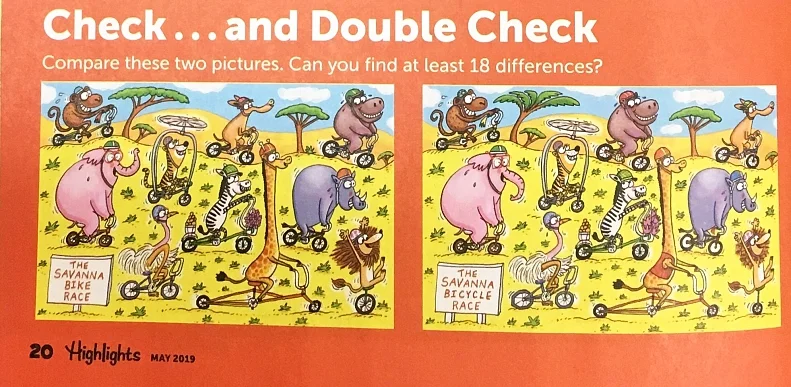
 Troy Patterson
This hCard created with the hCard creator.
 Middle School Matters Content
© 2026 Troy Patterson
Theme by Anders Noren — Up ↑

